
The Concert Sinatra
Part I

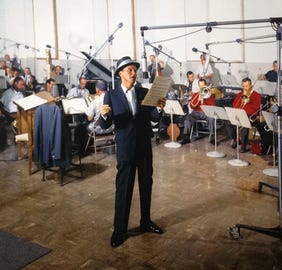
On February 18, 1963 from 8pm-11:15pm Frank Sinatra recorded the definitive version of Lost in the Stars.
This iconic recording is featured on the album “The Concert Sinatra.” As performed by Frank Sinatra, arguably the greatest interpretive artist of the Twentieth Century accompanied by Nelson Riddle, arguably the greatest vocal arrangerof the century, this album is nothing less than an epochal commemoration of the Great American Songbook.
Consisting of eight theatrical masterpieces performed by Sinatra in a 'semi-classical' concert style the album is one of the crown jewels of the great singer’s recorded repertoire.
“The Concert Sinatra” is so named for its elevated artistic endeavor, not because it represents a live performance. But, although the album was a carefully designed studio production, make no mistake, “The Concert Sinatra” is serious symphonic music. Not least Lost in the Stars.
The album marks a reunion between Sinatra and Nelson Riddle; it was the first full-album Riddle arranged on Sinatra's Reprise Records label. To support Sinatra aspirations, Riddle assembled a large scale orchestral contingent consisting of 76 musicians, the largest ever assembled for a Sinatra album.
Adding to the concert hall ambience Sinatra took the extraordinary step of recording the album on a large Hollywood film soundstage – Samuel Goldwyn’s Stage 7 – where each track was set down on 35mm magnetic film.
Written for the 1949 Broadway musical of the same name by the virtuoso German/Jewish expatriate composer Kurt Weill with lyrics from the American poet/playwright Maxwell Anderson and based on South African writer Alan Paton’s 1948 novel “Cry the Beloved Country,” Lost in the Stars retains a universal appeal but it also displays a specific post-World War II “zeitgeist.”
Written in 1949 the song expresses a singular post-World War II philosophical perspective. When the war ended many saw the world in a very different way than they had before. Given the war’s widespread destruction and loss of life, many – especially those with a European sensibility – began to question the existence of a benevolent God. “Where has God gone?” was the anguished cry. Where was God through it all? And Lost in the Stars can be seen as a creative musical expression of that vexing question.
The construction of Lost in the Stars incorporates two self-contained movements. The first three stanzas set the scene and offer a recital of the traditional order of the world, a story of faith and hopeful promise. Those promising opening stanzas are followed by the fervent final chorus with its darker vision of despair and isolation in a world absent of divine presence, a world that leaves us feeling lost, alone, and disconnected.
Sinatra’s timeless performance of this haunting song, with its profound message and Nelson Riddle’s mood evoking impressionist accompaniment, elicits an emotional response that captivates listeners to this day.
Sinatra and Riddle conceive the song as a symphonic poem layered with an impressionist mood and atmosphere. The recording opens with an unforgettable overture. A circular melodic movement anchored by Harry Klee’s flute sets the tone with a discordant motif as Riddle’s serves up an impressionist picture of a celestial firmament scattered with stars. The swirling repetition reinforces the song’s underlying theme of a search for meaning in a vast and uncertain world.
Still dissonant, the tempo slows and Sinatra delivers a stunning opening stanza. Just hear the way he shapes and unfolds the word, “stars.”
Before Lord God made the sea or the land
He held all the stars in the palm of his hand
And they ran through his fingers like grains of sand
And one little star fell alone.
Sinatra’s delivers the song’s first movement of expectant promise and longing with such intensity and fervor that, for a brief second, you feel the sun is shining through. And then his “But I've been walking through the night and the day” dramatically transitions the song’s narrative from the first movement theme of redeeming hope to the chorus and its despair of an empty world. And, oh my, his phrasing? Just listen to him convey estrangement as he sings, “And sometimes it seems maybe God's gone away, forgetting his promise and the word he'd say . . . “ .
The epilogue is delivered quietly. All you hear is the fateful acceptance in the singer's voice at his breathtaking finale, “And we're lost out here in the stars,” a reprise of the opening discordant motif and the pathos of a last wistful “ping” from a lost star.
Frank Sinatra turns popular singing into art. He delivers a perfectly realized, deeply satisfying performance of unparalleled beauty and emotional sincerity. His phrasing, his enunciation of each word, his timing with the orchestra, his silences and his breathing . . . remind us that Sinatra could articulate existential solitude with more conviction than any singer on the planet. Who else could sing those lyrics with such expression and authenticity?
Sinatra recorded an earlier version of Lost in the Stars in 1949 with an Axel Stordahl arrangement during his tenure with Columbia Records. It is quite wonderful and well worth a listen. It was released as a single in the 78 RPM format.
Kurt Weill was born March 2, 1900 in Dessau, Germany. The German-born American composer was celebrated throughout the 1920s in Germany as an outstanding composer for the stage and for his popular collaborations with Bertolt Brecht – most famously ”Mahagonny” in 1927 and “The Threepenny Opera” in 1928.
His Jewish birth made him a pariah in Nazi Germany. Officially denounced for his political views and sympathies, Weill was singled out and targeted by Nazi authorities who criticized his compositions and physically interfered with the performances of his works.
In March 1933 Weill fled Nazi Germany and resumed his career in New York City where he very successfully wrote music for plays appearing on Broadway.
Weill's had a distinctive and original style. Two of his songs in particular, Mack the Knife from “The Threepenny Opera” and September Song from “Knickerbocker Holiday” have remained popular standards. Lost in the Stars was Kurt Weill’s last work completed just before he died in 1950.
The sweep and majesty of "The Concert Sinatra" is breathtaking. This 1963 album is a singular triumph in a career filled with triumphs. Frank Sinatra at the pinnacle of his artistry. A stunning musical experience.
One of Sinatra’s best albums and songs. But a small quibble: I have never found this album to be the best sounding album they claim it to be, and I have high end equipment.
IMHO Sinatra’s Capitol album called Where Are You and Capitol’s box set of Sinatra Singles both have way better fidelity than The Concert Sinatra.
Full disclosure: I HAVE NOT HEARD the Concert Sinatra on reel to reel tape, so I may be talking through my hat. Can any one comment on this?
Michael, this album, and this song in particular, have been favorites of mine since I first listened to it. Now, with your wonderful backstory to the song and the recording it has so much more meaning. Once again, we have to thank you for how you bring Sinatra’s music to another level of understanding and appreciation. This song was also part of a great “live” special for television Sinatra performed in 1965. I can’t thank you enough for what you do. Now I need to bring this classic album back to my Sinatra playlist! I am always excited to receive your work. Please keep it coming!
All the best…..Jim C.