
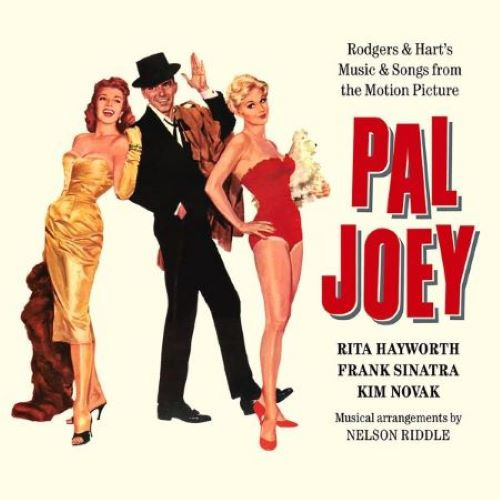
Pal Joey

The pivotal scene in Jean-Luc Godard's classic 1960 French New Wave film “Breathless” finds Jean-Paul Belmondo standing in front of a movie theater wearing a fedora hat, brim down, a cigarette dangling from his lips, looking up at a larger than life film poster image of Humphrey Bogart . . . imitating Bogart’s onscreen mannerism he removes the cigarette, strokes his lips with his thumb, and whispers, “Bogey.”
Belmondo’s protagonist exemplifies the antihero archetype . . . he wants to be a “cool” tough guy in the manner of Humphrey Bogart.
Bogart’s on-screen image had something more than just “cool.” Tough, cynical, even mercenary, but when push came to shove, he unfailingly lived up to a certain moral code. Humphry Bogart’s film persona typifies a tough guy with principles.
Bogart’s “I stick my neck out for nobody” Rick in Casablanca finds himself torn between following his heart and following his personal code of ethics. “I’m no good at being noble," he tells Ingrid Bergman in the film’s memorable climatic airport scene. But, of course, he’s about to make just such a noble sacrifice.
The sway of Bogart’s “cool” anti-hero persona has endured through generations. His anti-hero persona left a lasting legacy . . . audiences are drawn to his enigmatic anti-hero. Bogart made it “cool” to be honorable.
What does this have to do with Sinatra’s portrayal of Joey in the 1957 film “Pal Joey”?
Sinatra had a friendship with Humphrey Bogart and a natural affinity for Bogart’s film persona. Bogart’s anti-hero persona fit Sinatra like a glove.
In the early 1950s Sinatra was part of a fun-loving social circle of hard-drinking Hollywood night owls who would convene at the home of Humphrey Bogart and Lauren Bacall in the Holmby Hills neighborhood of Los Angeles. Bogart was the ringleader of the original group but after Bogart's death the focus shifted to Sinatra.
And in 1957 when Sinatra filmed “Pal Joey,” it was almost instinctive for him to craft his portrayal of Joey in the mold of Bogart’s tough guy with principles anti-hero.
Sinatra delivers a brilliant performance in the film. His “Joey” is a morally ambiguous self-serving heel, but while his actions may be questionable and unsympathetic, Sinatra fashions a “Joey” that is nonetheless very relatable. Bursting with sprightly nonchalance and carefree energy, “Joey” has such captivating charm the audience can excuse his reprehensible actions and still root for him in the end.
Just like the ethical dilemma of Bogart’s Rick in “Casablanca,” Sinatra’s Joey finds himself conflicted between achieving the dream of owning his own nightclub and following a personal code of ethics in the form of Kim Novak’s “Linda.” And just like Bogart’s Rick, in the end, bound by his own sense of morality, he chooses the noble course of action.
But, first and foremost, “Pal Joey” is a musical that stars a singular American artist, the preeminent singer of his generation. We cannot talk about Sinatra’s onscreen persona, his anti-hero swagger, his effortless “cool,” without referencing the film’s legendary centerpiece musical scene –Sinatra’s simply transcendent performance of The Lady is a Tramp.
The film’s plot is simple. Joey’s ambition is to open his own nightclub and he’s trying to entice a wealthy widow, the beautiful Vera Simpson – played by Rita Hayworth -- into financing his dream. Intrigued by Joey’s brashness Vera makes an impromptu late night appearance at the second-rate San Francisco nightclub where Joey performs and asks him for a song. Joey sings The Lady Is a Tramp.
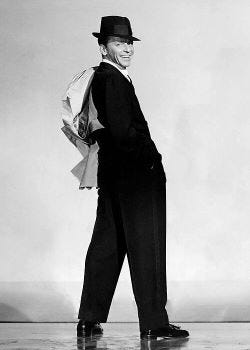
Sinatra’s bravado, his nonchalant cool demeanor, his sparkling gestures -- exhaling cigarette smoke, pushing the piano away with his foot, snapping his head to the band – are priceless. His performance is a bewitching seduction by way of risqué song. With the word “tramp” Rita Hayworth does a perfect wince.
“Pal Joey” serves as a backdrop for the presentation of a not-so-perfect protagonist and the classic Rodgers and Hart song could not be a more perfect vehicle. Skewering high society social pretensions, The Lady Is a Tramp is a send-up, a spoof of New York’s fussy high society and its strict etiquette. The society women call her a “tramp” because she refuses to conform to their way of life. The lady in question will not have any part of it.
Nelson Riddle’s masterful orchestration propels the song’s narrative forward. Gradually mounting in dynamics and intensity . . . building and building Bolero like . . . to a big finish crescendo.
Sinatra’s vocal exudes personal magnetism . . . his exceptional gift for tempo on full display he unites rhythm and melody into a harmonious whole. And oh there’s that wonderfully electric edge to his voice.
Author and Sinatra oracle Will Friedwald points to the singer’s marvelous device of delivering one phrase a cappella. Listen as the band lays out and Sinatra sings “She’s broke” in the open, the brass crashes back in, then drops out once more but now instead of singing “its oke,” Sinatra, in a moment of serene nonchalance, simply pauses for three beats, shrugging his shoulders. Talk about carefree insouciance. Such an iconic expression of “cool.”
The Lady Is a Tramp did not appear in “Pal Joey” the 1940 Rodgers and Hart Broadway musical with a book by John O'Hara. The Broadway version centered on a dancer not a singer and the role of Joey was the first big Broadway success for the great Gene Kelly. A show tune from the 1937 Rodgers and Hart musical “Babes in Arms,” The Lady Is a Tramp was added to the 1957 film adaptation of “Pal Joey” starring Sinatra, Rita Hayworth, and Kim Novak.
Although The Lady is a Tramp was composed as a send up of New York high society mores . . . as Nelson Riddle said, Sinatra gave it a very salacious edge.
Sinatra won the Golden Globe for Best Actor in a Musical for his role as the irreverent Joey. Pal Joey earned four Academy Award nominations.
Sinatra refused top billing in Pal Joey, which went to Rita Hayworth. Sinatra was a much bigger star at the time and had the title role . . . When asked about the billing, Sinatra replied, "Ladies first."
Pal Joey was a critical and box office success. Sinatra’s earnings from the film paid for his new home in Palm Springs. He also opened a restaurant in Palm Springs named “Pal Joey's.”
In Sinatra’s 1967 television special he performs a much acclaimed swinging duet of The Lady is a Tramp with Ella Fitzgerald. A very special moment readily available YouTube.
Thank you Michael for another wonder gem from Sinatra. Your insight is mind boggling. I so appreciate your work and look forward to every post. Keep up the great work. I can tell it’s a work of love. I still miss your podcasts 🥲.
Stay well…….