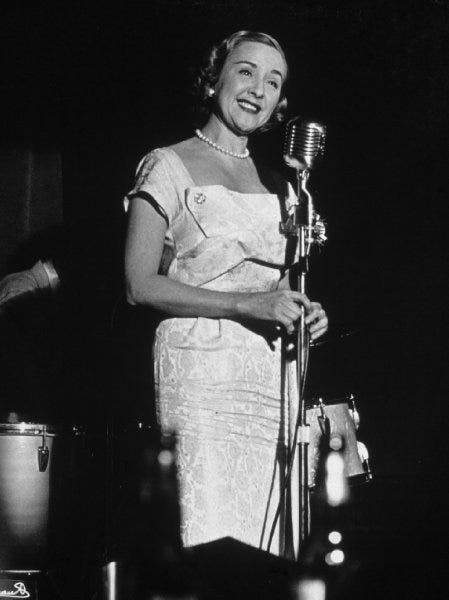
Lee Wiley

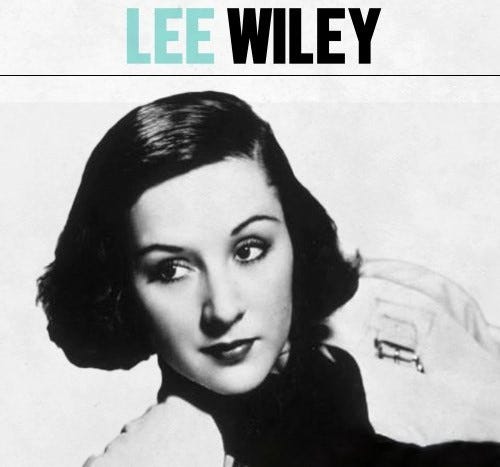
I am not alone in having been influenced by the writing of celebrated music critic Will Friedwald. For one thing his 1990 book “Jazz Singing” introduced me to the recordings of jazz and pop vocalist Lee Willey. And Lee Willey is special.
A pioneer jazz vocalist, her weathered delivery, so languid and feathery, will give you goosebumps. And oh that signature vibrato quaver. Friedwald offers a wonderful description, “Lee Wiley,” he wrote, "blows smoke rings, each note a puff that melts into wisps of vibrato." You can’t say it any better.
Lee Wiley’s allure evokes strong adherence from her jazz connoisseur audience and her hot and cold enigmatic personality fuels the fascination. Indeed, Lee Wiley’s mystique stems partly from her silky sensual sound and her cool detached vocal style and partly from her captivating persona. Lee Wiley was something of a strange and wonderful enigma.
To begin with she was drop dead gorgeous – tall and willowy, with chestnut hair that tumbled past her shoulders and smooth olive skin. According to the late jazz historian Dan Morgenstern, Lee Willey possessed “a smoldering sex appeal.”
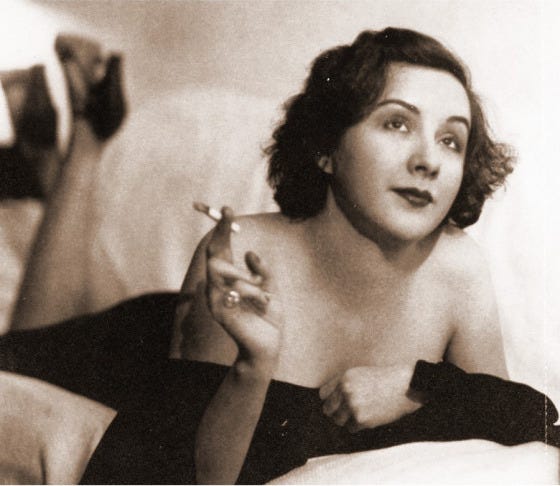
Her friend singer Barbara Lea said of her, "She had more fire, more roughness, more silkiness, and more deep personal warmth, than the job description of Pop Singer called for." She also, by all accounts, could be an irascible outrageously confrontational diva. Ex-husband, pianist Jess Stacy, famously said of Wiley, “Not all the witches were in Salem.” Ouch.
Whatever else she might’ve been Lee Willey was one of the most graceful, lyrical, iconic vocalists of all time. That throaty whisper, the plummy voice, her immaculate sense of time, and her sensuous vibrato mark a singular stylistic trademark. Lee Wiley was unique.
Born October 9, 1908 (Maybe. The dates are fuzzy.) in Fort Gibson Oklahoma. She was descended from a princess of the Cherokee tribe (also maybe.) She wanted to sing and at just fifteen took off on her own running away from home and Oklahoma. Singing at every opportunity she eventually arrived in New York in 1931 and soon landed a spot as a regular on society bandleader Leo Reisman’s radio show. Influenced by Mildred Bailey and Ethel Waters, she had a hit record with Reisman in 1931 -- Time on My Hands.
That kick started a solo career and throughout the 1930s she regularly found herself in the recording studio backed by the Casa Loma Orchestra or the Dorsey Brothers or Johnny Green. Along the way, gaps in her recording career occurred first when she was badly injured in a fall off a horse and then when she nearly died from tuberculosis.
Recovered from the dual calamities, Wiley began developing a particular affinity for popular songs composed by the era’s greatest composers. In the late 1930s she recorded several albums each centered on the work of a single composer -- the Gershwins, Cole Porter, Rodgers & Hart, and Harold Arlen. These “songbook” recordings pre-dated Ella Fitzgerald’s celebrated “songbook” series. Lee Wiley was a cutting-edge jazz trailblazer.
In the 1940s Willey became closely associated with jazz guitarist and bandleader Eddie Condon. Condon, a prominent jazz fixture, owned a night club on 52nd Street in Manhattan . . . and 52nd Street was the center of jazz performance from the 1930s to the 1950s. Wiley was now working with the cream of the crop of New York jazz musicians -- Bunny Berigan, Bobby Hackett, Billy Butterfield, Pee Wee Russell, Bud Freeman, Ralph Sutton, Joe Bushkin, Fats Waller, as well as Benny Goodman pianist Jess Stacy (who she was married to for several tumultuous years).
Along with Connee Boswell and Mildred Bailey, Lee Wiley was one of the quintessential 1930s songstresses. And like them, by the early 1950s she was fading from view. The Condon years were behind her when she signed with Columbia Records in 1950 and delivered one of her finest albums – “Night in Manhattan.”
Then in 1956 she moved to RCA Victor and recorded what I regard as her masterpiece album -- “West of The Moon.” Backed by wonderful arrangements from Ralph Burns, this is a perfectly realized, deeply satisfying recording. I think it’s the high water mark of Lee Wiley’s musical legacy. For me “West of The Moon” is, without question, one of the finest jazz vocal or pop vocal albums of the 1950s.
Her rendition of My Ideal is especially memorable. She is in prime form, her cool delivery, perfect diction and elegant phrasing on display. Ralph Burns’ spare arrangement fits her like a glove and provides a showcase for Wiley's sensuous vibrato.
First recorded by Maurice Chevalier, My Ideal was written in 1930 with music by the great Richard Whiting along with Newell Chase and that wistful lyric by Leo Robin. The song is a favorite of mine and Lee Wiley delivers, arguably, the definitive rendition.
Ralph Burns designed a soft harp centered prologue and Lee Wiley delivers the wistful verse with breezy grace.
She has reduced the chorus to its bare simplicity . . . Her phrasing masterful, just listen to the way she alters the tone and dynamic of the word “find” in the opening line, her silky voice intimate and vulnerable. And hear her rubato shape the word “corner” in the phrase, “Just around the corner waiting for me.”
Extending and bending notes at the bridge she carves a languorous musical line. Her falling vibrato on the words “recognize” and “reveal,” the hypnotic timbre, her plummy perfect diction, the elegant phrasing and that little grace note pause for final effect.
At the close, her light and airy lyrical qualities on display, she exquisitely extends the final line delivering, “Or will I pass him by and never even know” -- with a pause just lingering for a breathless instant before she finishes the phrase, “that he is my ideal?” Good heavens.
I can never get enough so just one more. Lee Wiley could swing – she had a wonderful laid back swinging style. Dig her propulsive swing feel on Fats Waller’s Keeping Out of Mischief Now.
The great trumpeter Billy Butterfield, ever mindful of Bix Beiderbecke, the pivotal 1920s cornetist, leads her over the traces. The band heats up and Butterfield swings a solo break. Wiley joins the fun unfolding some high-spirited improvisation at the release . . . her swing gives the music a bouncy, lively feel but remains a model of relaxation. Wonderful stuff.
In 1975 Lee Wiley passed away in New York.
She did not become a major commercial success, she never achieved broad popular acclaim but jazz literati – then and now -- hold her in high esteem. Her place among the great jazz singers is secure.
There’s the languid, musicality of her cool delivery, that lingering breathy note seemingly just floating in the air that so resonates with the listener. Timeless. Lee Wiley won’t be forgotten any time soon.