
Della

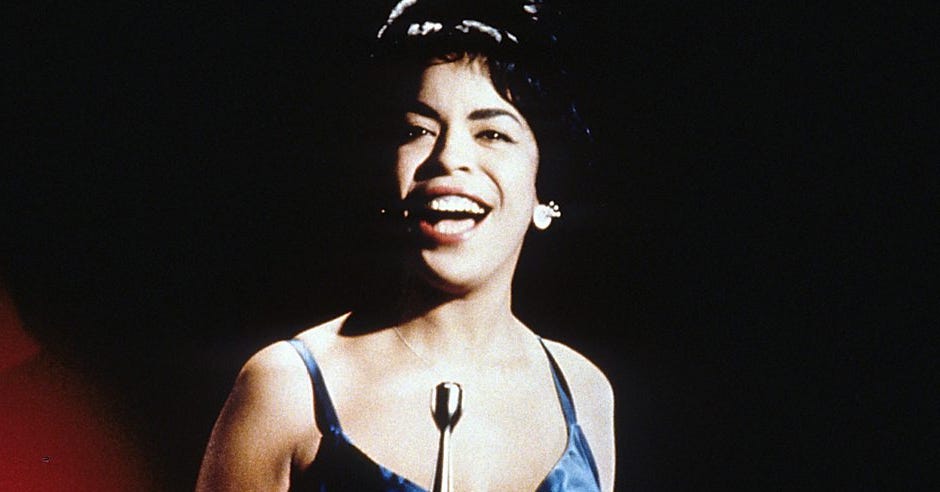
I was a great admirer of the 1958 Count Basie/Neal Hefti album “Atomic Basie” so back in 1960 when I heard that Hefti had arranged an album for Della Reese I quickly bought it. At the time I wasn’t overly familiar with Della Reese but I knew and liked both her recording of And That Reminds Me and her huge 1959 hit single Don’t You Know so I was intrigued to hear what would come of her pairing with Hefti.
The album is titled simply Della and it just knocked my socks off. Every track is star-quality. Della Reese is a vocal dynamo. To say she has a powerhouse voice is an understatement. It’s an instantly recognizable big husky voice, rich in tone and dynamics.
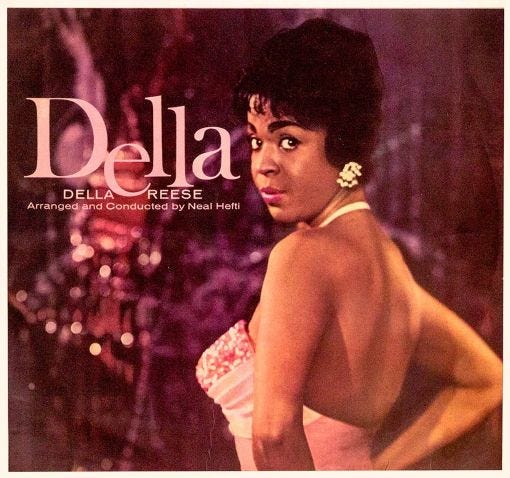
The cover art features a sassy Della delivering a flirtatious over the shoulder look perfectly in tune with the joy and passion of her performance.
The album is a collection of twelve jazz and pop standards, among them Matt Dennis and Tom Adair’s 1941 hit popularized by Sinatra Let’s Get Away from It All throughout which Reese improvises a handful of lyric changes. She alters “I’ll repeat that I love you sweet! in all the forty-eight” to a superbly hip “I’ll repeat I think you’re nifty In every state and I know there’s fifty.”
There’s a gloriously vibrant rendition of “You’re Driving Me Crazy.” Written in 1930 by Walter Donaldson the song’s chords serve as the foundation for jazz classic Moten Swing and Hefti’s arrangement incorporates a swinging unison brass figure lifted from Count Basie‘s hit recording of Moten Swing. Wow.
With an electric edge to her sound Della seizes your attention with an unforgettable rendition of And the Angels Sing. Composed in 1941 by Ziggy Elman and Johnny Mercer for the Benny Goodman Orchestra the song has an irresistible, buoyant quality. Backed by Hefti’s driving unison brass and a rhythmic foundation laid by vibraphone and bass, Della’s unique “talk-sing” phrasing is on full display.
There’s I’m Beginning to See the Light. Written in 1944 with music by Duke Ellington, Johnny Hodges, and Harry James and lyrics by Don George it’s an unforgettable song . . . that melodic repeated phrase in the chorus gets stuck in your head. Hefti delivers one of his irresistible melodic hooks and a magnetic call and response interlude. Della’s vocal exudes high voltage energy, her gift for tempo showcased. Oh that wonderfully rich smoky edge to her voice.
And there’s still more. Della can sing tenderly as on her slightly salacious rendition of If I Could Be with You and her achingly lovely Baby, Won’t You Please Come Home. And she can swing as her performance on Blue Skies and Thou Swell prove. Every track is a gem.
“Della” was her first album with RCA Victor and the producers -- Brill Building veterans Hugo Peretti and Luigi Creatore wanted to capture her vocal dynamo style. With that in mind the album’s opening track is a rollicking Della Reese take on The Lady Is a Tramp.
A show tune from the 1937 Richard Rodgers and Lorenz Hart musical “Babes in Arms,” The Lady Is a Tramp with its unforgettable Richard Rodgers melody and witty Lorenz Hart lyric has a place of honor in the Great American Songbook.
And what a song it is. Skewering high society social pretensions, The Lady Is a Tramp is a send up, a spoof of New York’s fussy high society and its strict etiquette. The society women call her a “tramp” because she refuses to conform to their way of life. The lady in question will not have any part of it.
The Lady Is a Tramp presented a challenge for Della Reese because the definitive recording is forever associated with Frank Sinatra. Sinatra’s recording is a classic but Reese and Hefti, to their credit, do not even try to emulate Sinatra’s version. Hefti’s catchy repeated vamp forms a foundation for the orchestration while Della propels the song’s narrative forward with effortless charm and wit.
That repeated brassy vamp at the opening establishes a rhythmic feel and energy complemented by Della’s electric-edged “I get too hungry” swinging entrance. The tune’s suggestive innuendo marks the recording as an infectiously delicious celebration of Della’s “swing easy” charm.
Improvising new lines, playfully infusing her personality into the song, Della leaves her unique stamp on The Lady Is a Tramp. For example there’s this delightful twist,
I get much too hungry to be waiting for dinner at eight
I’m ca-razy about the theatre but I don’t dig it if I’m late
Who’s got time to be bothered with people you know you hate
And so they say this lady is a tramp
More playful at the bridge, a vibraphone’s percussive barrage of fills accentuating her vocal lines. Instead of singing “she’s broke but its oke” with carefree insouciance Della ad libs “I’m broke, okey doke.” Upping her intensity and timbre, dig her soaring close to the stanza “and so they say this lady is a tramp.”
A towering crescendo to close the show beginning with Della’s blistering, “Don’t like Guy Lombardo I dig Basie, Ellington and Hamp.” Listen to her drag out the phrase “And so they say this lady is a tramp.” Wow. At the coda, her voice deepened to a husky resonance, a dramatically triumphant “But it’s swingin’ so let’em sing I’m a tramp.”
Exuding witty bravado and personal magnetism Della Reese’s completely personalizes the song, making this cover version of The Lady Is a Tramp feel absolutely original, her whimsical spin a standalone delight. And Neal Hefti does his part creating a fresh, finger-snapping vamp that gets repeated as fill throughout.
Someday You’ll Want Me to Want You was written in 1944 by country music composer Jimmie Hodges. The song originally categorized as “hillbilly” became a standard recorded by many country music singers including Elton Britt, Gene Autry and Eddy Arnold. Vaughn Monroe turned it into a mainstream pop hit in 1949 reaching number 1 on the Billboard Best Seller chart.
Arranged by Neal Hefti, Della Reese’s legendary 5 minute plus reading of the song is nothing less than a tour de force.
A word about the structure of Someday You’ll Want Me to Want You. The song’s underpinning lies in the repetition of three verses with lyrics that change each time and contain the main hook. The verses are followed by a dramatic outro refrain that offers closure while reinforcing the “I will endure this and then I won’t need you” declaration.
With an almost regretful sigh Della delivers the curtain raiser with an a capella, “I know that someday” entrance. Gliding from one note to the next, supported by a Freddy Green like rhythm guitar, a swing easy tempo, and vibraphone fills she delivers each of the three verses gradually mounting in dynamics and volume. Hear how she stretches and bends the lyric at “when I’m in love with somebody else” and her syncopated diction at “I think that I know how to forget about you.”
Della’s protagonist renounces her dependence and declares her self-sufficiency taking flight at “And although you don’t want me now.” The orchestra joins the fun adding sharp brass punctuation after “And then I…” followed by more Hefti brass hammer “bang-bangs” after “won’t…” – ending with “…want you.”
With a nod toward the classic Count Basie false ending and Basie’s “One More Time” shout off his April in Paris recording Della delivers an absolutely electrifying virtuoso performance repeating the outro five times with a “false climax” each time creating suspense where the audience thinks the peak has been reached only to build even higher with an extended, explosive ending “breakdown.”
With seemingly unstoppable energy Della and the raucous Hefti band carry on for just one more wildly swinging chorus. Her five repetitions of the outro sounding deliciously spontaneous, her husky voice glistening with style Della heads for a yet another climax with a contagious delivery of, “I like it, I like it, I like it.“ The ensemble joins in leading to a rousing finish and Della’s towering “Maybe then I won’t want you.” My heavens.
The album helped introduce Della Reese to a wider audience and was a major commercial success landing a Grammy nomination.
I also love her album Della by Starlight recorded the same year. Arranged and conducted by Glenn Osser she wraps that rich, unmistakable Della Reese sound around a series of ballads. It too is a simply marvelous album.
Because of her later fame as an actress – notably for playing the much beloved wise angel in the television show “Touched By An Angel” -- Della Reese is often overlooked as a singer. She is a truly great singer with a commanding voice and a distinct, instantly recognizable sound. There’s nobody quite like her.
Here’s a bonus. Della with a live performance of Someday.
Shame on me for having no Della in my collection. That may change after your piece. It did do a radio show in Chicago about Hefti’s music. My friend the singer, Frank D’Rhone, airchecked the show and sent a cassette to Neal in LA. A week later, to my great surprise, Neal called me and we chatted for nearly an hour. I was struck by how humble he was. A great shame he stopped writing music. The reason as told to me was the death of his wife, Francis Wayne. When she died in 1976 his muse went with her.